
Build communication systems that drive clarity, trust, and action
I work with leaders to transform scattered messaging into structured, scalable systems - powered by AI, guided by LEAN, and grounded in human-centered storytelling and neuroscience.
Let’s design a system that scales your voice, sharpens your strategy, and speaks human.
Storytelling that moves people - and strategy that moves business
I’m Jeanette Fabros Knudsen - strategic advisor, brand storyteller, and founder of Fabros Agency. I help leaders and businesses craft communication systems that build trust, drive alignment, and scale their voice - with storytelling at the core.
Over the past 12+ years, I’ve worked with global organizations like FLSmidth, Novo Nordisk, the UN, and the Danish Ministry of Foreign Affairs - helping transform complex ideas into clear, compelling narratives that spark action.
My approach: Strategy meets story
At Fabros, storytelling isn’t a soft skill - it’s a system for clarity, connection, and leadership at scale.

Trusted by leaders at:



Why Communication Is Your Most Powerful Tool Today
In complex, high-stakes environments, it's not the smartest strategy that wins - it’s the one people understand, believe in,and act on.
Here's why communication is your most powerful competitive advantage:
1. It drives decision
Clarity drives action.
Strategic storytelling turns vision into confident decisions - not endless alignment meetings.
2. It builds trust
Consistency builds credibility.
When your message shows up aligned across leaders, platforms, and teams, trust compounds - and confusion disappears.
3. It speeds you up
Clear systems = faster execution.
Communication workflows reduce rework, delays, and “just checking” moments - so teams move with confidence.
4. It makes AI useful
AI is only as smart as your system.
I help leaders turn AI from a noisy tool into a powerful amplifier, guided by clear messaging standards and ethical guardrails.
5. It breaks silos
Alignment beats assumptions.
Great communication flexes across departments and cultures, without losing clarity or direction.
6. It scales you
Your voice, even when you're not in the room.
Communication systems make your leadership presence scalable, across teams, time zones, and platforms.
Who I work with:
Leaders & Experts
For consultants, advisors, and executives ready to amplify their voice.
I help you design a signature story and messaging system that builds credibility, trust, and traction - online and off.
- Personal brand positioning
- Thought leadership content systems
- Visibility strategy with clarity and purpose
Businesses & Boards
For executive teams navigating complexity, change, or growth.
I help you align leadership messaging, streamline internal communication, and bring clarity across cultures and silos.
- Strategic communication audits & systems
- AI-integrated workflows for alignment at scale
- Story-driven messaging that builds trust across orgs
Whether you're a team of one or a leadership team of 20, the goal is the same: communication that drives clarity, trust, and aligned action at scale.
Curious if this fits your context?
Let’s explore what communication systems could do for your voice, vision, and velocity.
What others are saying about Jeanette Fabros:


Kristen Tate
Senior Director, Head of Communications and Media Relations, Danfoss
Jeanette is a creative problem-solver who approaches her work with a mix of curiosity and skill. Leaders turn to her for sound judgment, thoughtful guidance, and trusted, strategic counsel.

Rasmus Windfeld
Director, Group Media Relations, Rockwool
“I’ve seen Jeanette bring structure and creativity into complex communication challenges. She knows how to cut through the noise and make leaders’ messages land with impact and credibility. Jeanette turns communication into a true leadership advantage.”
Let’s build your AI-powered messaging strategy - one that aligns with your goals and speaks human.
Stay updated on strategic communication
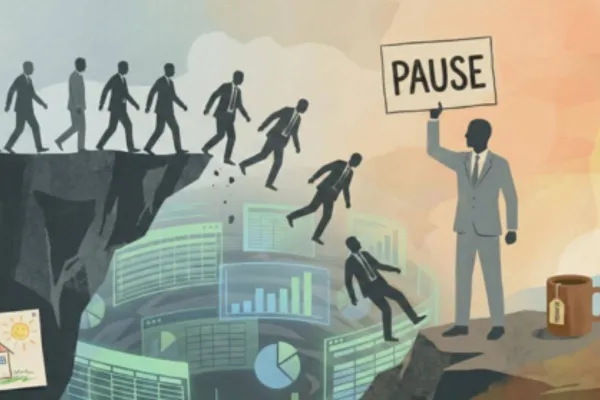
The Lemming Effect in Suits - When Systems Slowly Eat People
Welcome to the Blog
The Leadership Lemming Effect
Leadership sets the tone but not always in the way we hope.
At Fabros Agency, we call this The Leadership Lemming Effect:
A pattern where leadership behavior - conscious or not, ethical or otherwise - quietly cascades through an organization.
It shapes culture. It rewrites norms. And it teaches people how to survive.
We’ve all seen it:
Pressure at the top becomes policy in the middle
Toxicity gets rebranded as “urgency”
And slowly, silently, people begin to trade values for validation
This blog explores what happens when leadership drifts and the human cost that follows.
Not through theory, but through real-world insights, observations, and stories from the frontlines of change, communication, and culture.
Because leadership isn’t just a title.
It’s a signal. A multiplier. A mirror.
And when leaders lose sight of their impact, the whole system moves - sometimes in the wrong direction.
Here, we question that drift.
We name the patterns.
We explore how to lead without the cliff.
Welcome to the conversation.
The Lemming Effect in suits - when systems slowly eat people
The Leadership Lemming Effect isn’t about dramatic collapses. It’s about slow, silent drift, when systems begin to normalize what should never feel normal.
This post explores what happens when language shifts, people become performance metrics, and no one stops to ask: at what cost?

There’s a silence you never forget.
The kind that fills a room when a desk is suddenly empty.
When no one asks what happened because everyone already knows.
When people glance up, then quietly return to their screens.
I’ve witnessed that silence more than once.
Not because people were fragile.
But because the system kept going.
It always does. And I have seen it more than once.
Not because people were weak.
But because the system never stopped.
The Modern Lemming Effect
The lemming myth is persistent: small creatures blindly following each other off a cliff.
It’s not entirely true in nature but it’s uncomfortably accurate in business.
In corporate life, lemming behavior looks like:
Saying yes to everything, even when it hurts
Prioritizing output over outcomes
Mirroring urgency, even when it’s unwarranted
Following KPIs instead of questioning purpose
No one wants to be the one who stops.
Because stopping feels like falling behind.
And so, we follow.
Not out of ignorance.
But out of incentivized survival.
That’s what makes it so dangerous:
It’s not ideology.
It’s normalised behavior within high-performance systems.
When people become spreadsheets
At some point in every high-performing system, language starts to shift.
Quietly. Almost imperceptibly.
People stop being people.
They become:
"Resources"
"Headcount"
"Capacity"
"Performance units"
Workload becomes “utilization.”
Sickness becomes “absence rate.”
Burnout becomes “turnover risk.”
Language that was once human becomes managerial.
We stop asking how people are doing and start tracking how they perform.
And one day, a human life is reduced to a row in Excel.
A line item in a quarterly report.
A percentage point on a dashboard.
It’s efficient.
It’s scalable.
And it’s deeply dehumanizing.
That is the moment when something essential, something unquantifiable, is lost.
Not productivity.
Not profit.
But the point.
The hidden cost no one budgets for
Every time a system collapses, the damage doesn’t just show up in numbers.
It shows up in lives.
Behind the data, there is often:
A family that didn’t get a present parent
A child who learned to shrink themselves to avoid stress
A partner who carried the emotional and practical load, alone
A professional, still blaming themselves for “not being strong enough”
These costs don’t show up in balance sheets.
But they compound - silently.
And still, we package it as:
“The market”
“The pressure”
“The reality”
As if it’s all external. As if we have no agency.
But we do.
Because this system wasn’t handed down by nature.
It was built.
Which means it can be rebuilt.
Why communication is no longer neutral
For years, I saw communication as my way to help, to translate complexity into clarity.
But I’ve come to realize:
Communication doesn’t just inform. It shapes what feels normal.
It:
Explains
Softens
Rationalizes
Reframes the unacceptable as "necessary"
If communication only exists to defend speed and performance, it becomes anesthesia -
a numbing agent for broken systems.
But when it tells the truth, and respects human limits, it becomes something else:
Leadership.
A question we have to ask
What if the most powerful leadership act today
is not acceleration but interruption?
What if the courage we need is not to push harder, but to ask:
Where are the boundaries?
Where are the pauses?
Where is the ethical line?
What’s the real cost of ignoring human consequence?
Not to make results weaker.
But to make them survivable.
Let’s rethink the system before it eats more people.
#Leadership #Communication #HumanFirst #OrganizationalHealth

Let’s build the story your strategy deserves - and the system to scale it.
Powered by AI. Grounded in clarity. Built for real leadership.
Copyrights by FABROS AGENCY 2025 | Terms & Conditions | Privacy Policy
© Fabros Holding ApS. All rights reserved. Used under license by Fabros Agency ApS. No reproduction, transmission, or distribution without written permission.