The Lemming Effect in Suits - When Systems Slowly Eat People
The Lemming Effect in suits - when systems slowly eat people
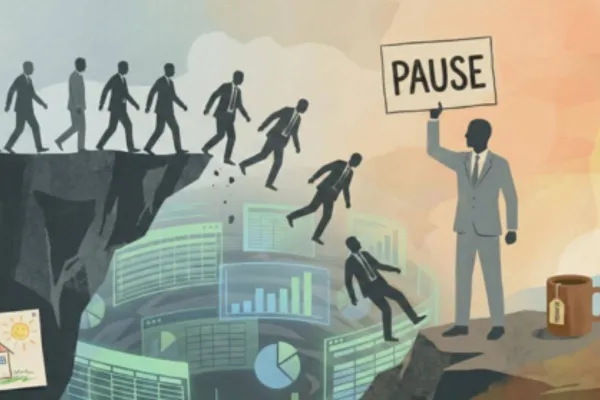
The Leadership Lemming Effect isn’t about dramatic collapses. It’s about slow, silent drift, when systems begin to normalize what should never feel normal.
This post explores what happens when language shifts, people become performance metrics, and no one stops to ask: at what cost?

There’s a silence you never forget.
The kind that fills a room when a desk is suddenly empty.
When no one asks what happened because everyone already knows.
When people glance up, then quietly return to their screens.
I’ve witnessed that silence more than once.
Not because people were fragile.
But because the system kept going.
It always does. And I have seen it more than once.
Not because people were weak.
But because the system never stopped.
The Modern Lemming Effect
The lemming myth is persistent: small creatures blindly following each other off a cliff.
It’s not entirely true in nature but it’s uncomfortably accurate in business.
In corporate life, lemming behavior looks like:
Saying yes to everything, even when it hurts
Prioritizing output over outcomes
Mirroring urgency, even when it’s unwarranted
Following KPIs instead of questioning purpose
No one wants to be the one who stops.
Because stopping feels like falling behind.
And so, we follow.
Not out of ignorance.
But out of incentivized survival.
That’s what makes it so dangerous:
It’s not ideology.
It’s normalised behavior within high-performance systems.
When people become spreadsheets
At some point in every high-performing system, language starts to shift.
Quietly. Almost imperceptibly.
People stop being people.
They become:
"Resources"
"Headcount"
"Capacity"
"Performance units"
Workload becomes “utilization.”
Sickness becomes “absence rate.”
Burnout becomes “turnover risk.”
Language that was once human becomes managerial.
We stop asking how people are doing and start tracking how they perform.
And one day, a human life is reduced to a row in Excel.
A line item in a quarterly report.
A percentage point on a dashboard.
It’s efficient.
It’s scalable.
And it’s deeply dehumanizing.
That is the moment when something essential, something unquantifiable, is lost.
Not productivity.
Not profit.
But the point.
The hidden cost no one budgets for
Every time a system collapses, the damage doesn’t just show up in numbers.
It shows up in lives.
Behind the data, there is often:
A family that didn’t get a present parent
A child who learned to shrink themselves to avoid stress
A partner who carried the emotional and practical load, alone
A professional, still blaming themselves for “not being strong enough”
These costs don’t show up in balance sheets.
But they compound - silently.
And still, we package it as:
“The market”
“The pressure”
“The reality”
As if it’s all external. As if we have no agency.
But we do.
Because this system wasn’t handed down by nature.
It was built.
Which means it can be rebuilt.
Why communication is no longer neutral
For years, I saw communication as my way to help, to translate complexity into clarity.
But I’ve come to realize:
Communication doesn’t just inform. It shapes what feels normal.
It:
Explains
Softens
Rationalizes
Reframes the unacceptable as "necessary"
If communication only exists to defend speed and performance, it becomes anesthesia -
a numbing agent for broken systems.
But when it tells the truth, and respects human limits, it becomes something else:
Leadership.
A question we have to ask
What if the most powerful leadership act today
is not acceleration but interruption?
What if the courage we need is not to push harder, but to ask:
Where are the boundaries?
Where are the pauses?
Where is the ethical line?
What’s the real cost of ignoring human consequence?
Not to make results weaker.
But to make them survivable.
Let’s rethink the system before it eats more people.
#Leadership #Communication #HumanFirst #OrganizationalHealth